

First Lady’s visit offers food for thought
By Emily Schmid on March 1, 2013 Leave a comment
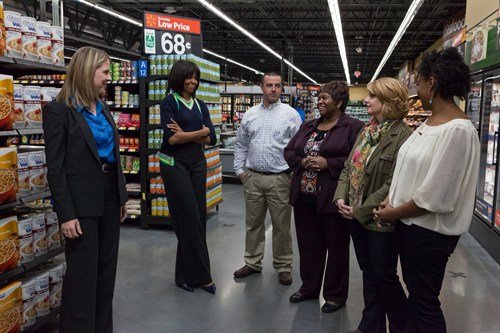
Springfield resident Stephanie Kennedy, third from right, speaks to First Lady Michelle Obama and Andrea Thomas, Walmart senior vice president of sustainability, and other local parents during a tour of a Neighborhood Market on Thursday.
More fresh fruits and vegetables. Less sugar and sodium. It seems like a simple formula for a healthier diet.
But actually, there’s a lot more to consider – and learn. What if you don’t have access to affordable produce? What if some foods may not be as healthy as they look? And on the business side, can food retailers and manufacturers bank on their customers consistently wanting these types of products?
Healthy eating is especially important for families with growing children, and all that’s involved can present some challenges. You’ve got to have the time to shop for, plan and prepare meals, and you’ve got to keep up with the latest information. For two years now, Walmart has been working to make the process easier.
We hope you read Andrea Thomas’ post about First Lady Michelle Obama’s visit yesterday to a Springfield, Mo., Neighborhood Market in celebration of our company’s progress on making food healthier and more affordable. The Green Room was there for her visit, too, and we came back with a few thought-provoking points.
Food deserts exist in not-so-obvious areas. Missouri is part of America’s heartland, and Springfield is a college town of more than 150,000 residents. That may not seem like the typical food desert, a term that can incite images of rural areas or very large cities where transportation is mostly on foot. But before the Neighborhood Market opened last year, the area of town where it’s located was defined as a food desert. That’s one of the reasons the store was built, and it’s a reason the First Lady chose it as part of her tour.
So, what exactly is a food desert? The USDA defines it as a “low-income census tract where a substantial number or share of residents has low access to a supermarket or large grocery store.” What does that low access mean? At least 500 people and/or at least 33 percent of the census tract’s population must live more than one mile from a supermarket or large grocery store. For rural census tracts, the distance is more than 10 miles. Curious about where other food deserts exist in the United States? The USDA offers an online locator.
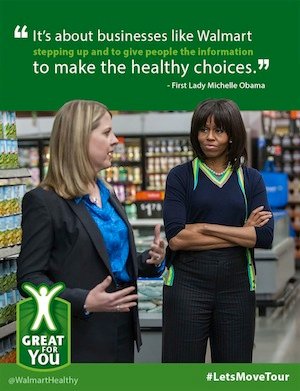 Sodium and sugar lurk in surprising places. A large part of Walmart’s healthier food commitment is improving the nutritional quality of our Great Value brand and other national food brands, and then posting a front-of-package icon that helps customers easily identify better choices. When thinking about reducing the salt in one’s diet, it’s easy to first think about eliminating frozen food or chips. But according to a recent report by the Centers for Disease Control and Prevention, the No. 1 source of sodium is a food you may not consider at all: bread. Yesterday, we shared that Walmart has helped reduce the sodium in commercial bread by 13 percent.
During a conference call with reporters yesterday, Andrea Thomas was asked if there were items that seemed obvious to qualify for our Great For You label but that Walmart had to go back and reformulate. One of her answers? Salsa, which exceeded the limit of sugar based on the Great For You criteria.
Companies offering healthier foods deliver stronger returns to their shareholders. During her remarks, the First Lady discussed how, several years ago, conventional wisdom said that healthy products didn’t sell. But today, 82 percent of people feel that it’s important for companies to offer affordable, healthier options, she said.
In a country where hot dogs and hamburgers are national favorites, Mrs. Obama’s comments that sales and demand are telling a different story are quite interesting. We’ve long known that healthier foods are good for our bodies – but now, we have confirmation that they are good for business, too.

 Loading ...
 Subscribe to The Green Room