

A Canadian website is making the case for greener business practices by sharing case studies of more sustainable business methods that also deliver to the bottom line.
ShareGreen.ca posts case studies from companies, government and non-profits that are finding more sustainable methods of operating and reaping bottom line benefits through reduced costs or new sources of revenue.
The site is powered by Walmart Canada.
“We believe the fastest way to get businesses to go green is to show them the economic benefits,” says Walmart Canada’s VP of Corporate Affairs & Sustainability, Andrew Pelletier. “Sharegreen is all about sharing examples of what works and what the benefits both environmental and economic are.”
Sharegreen was started out of the Walmart Green Business Summit held in 2010. Over 300 Canadian CEOs gathered in Vancouver to share case studies and workshop new ideas. Many of the participants wanted to keep the collaboration going, so Walmart Canada launched ShareGreen.ca.
Pelletier says Walmart was always very good at efficiency and the company has turned that expertise into greener business practices. “When our greener operations began to show real economic benefits, it got baked into our corporate DNA. Our greener practices now thrive in any economic environment.”
The ShareGreen case-study format is simple: what was the issue or challenge, what was the strategy or response, and what were the results, including the financial returns when it is possible to show them.
Some recent examples on the site:
Landmark redefines the home building industry.
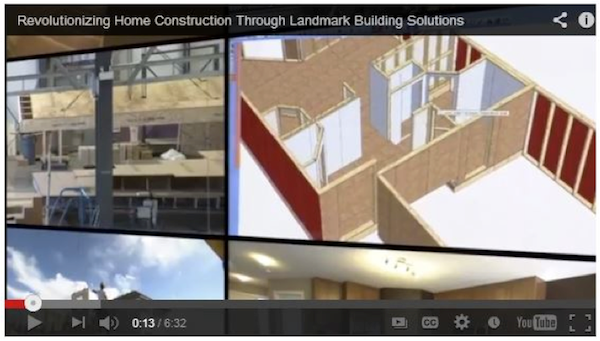
The Landmark Precision Building System (LPBS) is a fully automated, centralized process that creates a home’s major components in a controlled environment. It simplifies and makes it economical to produce a more precise, energy efficient home reducing the home’s operational carbon footprint by a minimum of 3.4 tonnes of CO2/home/year. Read more…
Walmart Canada’s Balzac Fresh Food Distribution Centre: A Living Lab Of Sustainablitiy
Walmart set the ambitious goal of building the most sustainable distribution centre possible while delivering a compelling return on investment.
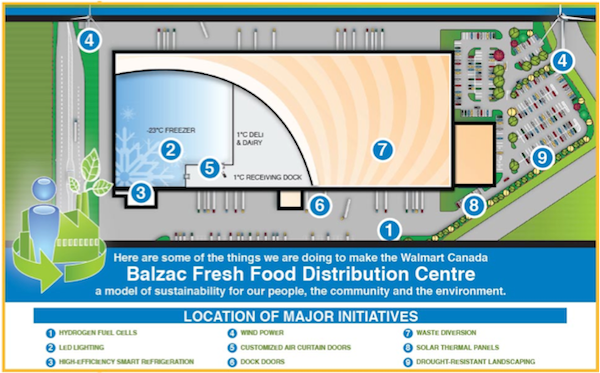
The Balzac Fresh Food Distribution Centre is a living lab that demonstrates sustainable operations, products and technologies including Hydrogen Fuel Cell Technology, Solid-State Lighting, Solar and Wind Energy, Energy-Efficiency and Sustainable Construction. The facility is an estimated 60 percent more energy-efficient than company’s traditional centres and will help avoid approximately $4.8 million in energy costs over 5 years. Read more…
Waste-To-Energy Solutions With Diacarbon
Biomass waste produced by forestry, agricultural, and urban sources is abundant, underutilized, and costly to dispose of. At the same time, rising fossil fuel prices, government incentives (carbon tax/penalties, carbon markets) and the need to reduce greenhouse gas emission are driving growth in the global bio-energy market.
Biomass needs to be upgraded to be used as a replacement for fossil fuels because unprocessed biomass is bulky, often containing 40-60 percent moisture with low energy density.
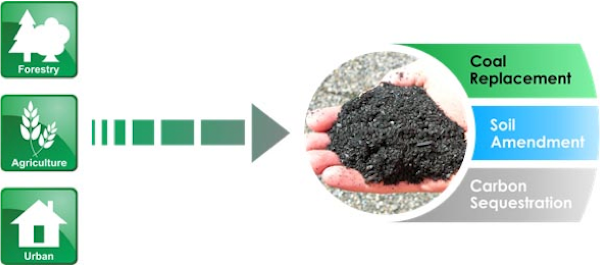
Diocarbon has developed the thermal biomass refinery (TBR) that provides a waste-to-energy solution that diverts waste streams while producing a carbon-neutral bio-coal that is a clean, direct replacement for coal. Read more…
ShareGreen is now accepting international case studies. Share the green initiatives your company is doing.
