

Growing Power
By Andrea Thomas on March 13, 2012 Leave a comment

When you are serious about sustainability, farming becomes a primary focus. We are in countries like China, training farmers to use fewer chemicals, and in Costa Rica, where our agronomists work with – and we buy directly from – small- and mid-size farmers.
And we are also in big cities in the U.S., supporting urban farms that are growing healthy, affordable food in sustainable ways.
Growing Power is an inspiring example. Founder Will Allen – a former professional basketball player and MacArthur “genius” grant recipient – actually built the Chicago Lights Urban Farm on top of an old basketball court.
Today, Growing Power is a national nonprofit that is training others around the country and the world in sustainable farming techniques that can be used in urban and rural areas: no synthetic chemicals, controlling pests with foliar compost tea and growing produce at or above organic standards. Will is passionate about healthy food and opportunity, and he has written a “good food” manifesto.
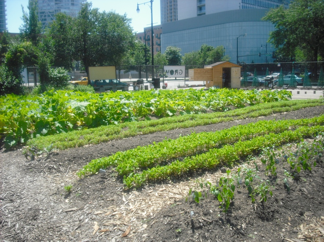 Walmart has been working with Growing Power since 2010. Organic waste from 10 of our stores is trucked to one of Growing Power’s Milwaukee sites where it joins more than 40 million pounds of organic waste to be converted into rich compost. At the urban farms in Milwaukee and Chicago, worms enhance the compost into a nutrient-rich soil conditioner that Growing Power then sells to gardeners or uses in its own production and community gardens.
But Walmart is sending more than just food waste to Growing Power. For the past couple of years, Southeastern Wisconsin Walmart stores have recruited countless groups of Walmart employees to volunteer at the Growing Power Community Food Center in Milwaukee. These volunteer groups have helped Growing Power accomplish large group projects and have also provided a small cushion of funding through Walmart’s Volunteerism Always Pays program.
In September, we took the next step with Growing Power: the Walmart Foundation gave the nonprofit $1,010,000 to expand its outreach.
Sixteen communities around the country are being trained in Growing Power’s techniques, and by the end of the grant period, four more will have joined. Communities like the Lower Ninth Ward of New Orleans are becoming Growing Power Regional Training Centers, at-risk youth are being empowered, and area residents will have fresh, affordable, sustainable produce.
When we started this blog, I committed to a conversation with you, so it is important to note here that Walmart’s contribution to Growing Power triggered controversy and criticism of this very worthy nonprofit.

Will Allen, farmer, founder and CEO of Growing Power
How could Growing Power accept funding from a big corporation? Walmart’s critics wanted answers, and Will Allen responded on the Growing Power blog by saying:
“We, as a society, can no longer refuse to invite big corporations to the table of the Good Food Revolution. Poverty, foodlessness, joblessness: these are problems we all face. They are not only the problems of the poor or of the urban – they are everyone’s problems. Walmart is the world’s largest distributor of food – there is no one better positioned to bring high-quality, locally grown food into urban food deserts and fast-food swamps.”
Growing Power is working with several stores to stock locally grown food from the organization’s various production sites, including products from their Rainbow Farmers Cooperative, which supports small and family farmers in the Midwest.
Environmental journalist Christopher Weber wrote, “It remains to be seen whether Walmart will be a good partner for the Good Food Revolution.”
I’ll be direct and say: we will be a good partner. We are committed to sustainability. It is the right thing to do, and it makes good business sense. We intend to lead the way, and we celebrate every time another company discovers this, too. 
Later this week, you will hear directly from the New Orleans program I mentioned that is being trained through Growing Power. It is called Our School at Blair Grocery and is located in an area that was devastated by the floodwaters following Hurricane Katrina. Stay tuned!

 Loading ...
 Subscribe to The Green Room