
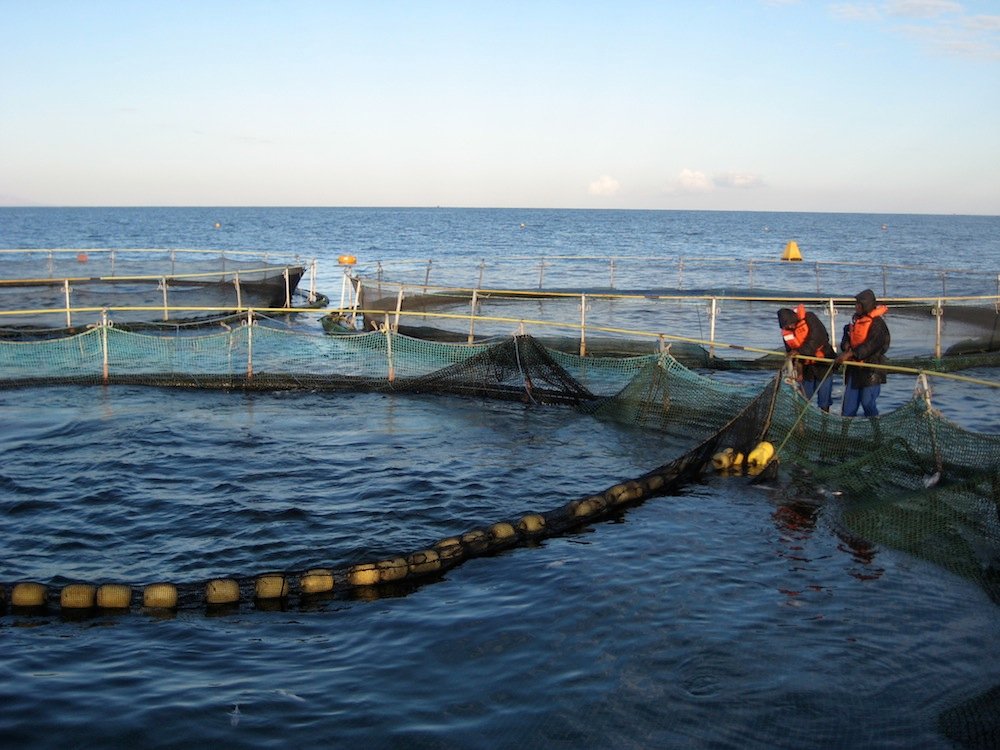
Aquaculture pens in Zimbabwe (photo credit: SFP)
There’s a lot of talk about how responsible consumers should skip seafood from unsustainable fisheries – fish that are on a ‘red’ or ‘avoid’ list from an environmental campaign group. It’s perfectly understandable why consumers would want to do this – no one wants to support the unsustainable exploitation of natural resources – but it fails to recognize one rather obvious fact: Even though responsible shoppers might shun a particular species, it doesn’t stop the fish getting caught and sold to someone else who doesn’t care.
Sustainable Fisheries Partnership (SFP) is a U.S.-based non-profit organization that was founded to try to solve this dilemma. Rather than asking businesses to reject fish from badly managed fisheries, the group recommends that companies actively engage in fishery improvement projects while continuing to source from problematic fisheries. SFP helps this process along by providing objective scientific data on the state of hundreds of fisheries (you can see for yourself at www.fishsource.com) and also bringing together retailers, processors, scientists, and fishermen to create projects that really make things better.
Walmart has been an enthusiastic supporter of SFP since the beginning, in 2006, and was one of SFP’s first corporate partners. It was also the first business to use a unique software package devised by SFP to manage the sustainability of seafood, and the two organizations have worked closely on developing the right policies for buying fish.

Seafood for sale, Philippines (photo credit: SFP)
Walmart now has a requirement that all seafood it sells must come from fisheries that are either certified to the standard of the Marine Stewardship Council, or an equivalent standard, or be part of a credible fishery improvement project. Many species cannot be obtained from certified fisheries, which means there is now an urgent need for fishery improvement projects to be put in place, and SFP is playing the lead role in providing advice and support to the supply chain to make these projects successful.
Walmart’s energy and vision have already spurred many improvement projects – for instance, some shrimp fisheries in the Gulf of California, the Russian king crab, Chilean hake, and the Louisiana blue swimming crab. There will be hundreds more fisheries to follow as Walmart engages with suppliers to make sure that sub-standard fisheries begin the improvement journey and can ultimately reach a level of performance that can gain MSC certification or meet an equivalent standard.
Of course, the “improvement approach” does not mean that all fisheries should be eligible to sell fish to Walmart. Those fisheries that have poor performance and fail to effectively engage in improvement projects will come under increasing pressure and may even be dropped as a supplier.

Gulf of Mexico shrimp FIP participants check out turtle excluding devices (TEDs) (photo credit: SFP)
Although the collaboration between Walmart and SFP started in the USA, it has already expanded overseas. ASDA – the Walmart division in Great Britain – is also a partner of SFP and has been supporting some visionary research around “ecosystem-based fisheries management” which aims to manage a fishery with regard to all the creatures in the environment, rather than just the target species. Walmart Canada has been a partner of SFP since 2011 and the organization is now developing links with Walmart offices all over the world.
And the improvement model is not just limited to wild fisheries. SFP has recently introduced “aquaculture improvement projects,” which aim to go beyond just addressing single farms by building initiatives that cover whole production areas. Projects for tilapia in China, pangasius in Vietnam, and shrimp in Indonesia are already started.
The improvement model pioneered by SFP and Walmart cannot pretend to be the whole answer to all the problems our oceans face, but it is proving to be an effective mechanism for mobilizing the seafood industry in rebuilding fisheries. Consumers can expect to hear good news about sustainable seafood in the months and years to come and look forward to eating their fish and shellfish with a clear conscience.
